

YH2 Capital Scholarship
Start a new Journey
Images courtesy of Magdalene College Cambridge.
Scholar Highlight: An interview with Zander Ong
Please provide a brief introduction about yourself.
I’m Zander Ong, from Kota Kinabalu, Sabah. I’m currently pursuing a BA in Law at Magdalene College, University of Cambridge, with the generous support of the YH2 Capital Scholarship. I completed my SPM at Sabah Tshung Tsin Secondary School, a Chinese Independent School, before continuing my studies at Kolej Yayasan UEM for A-Levels. Outside of academics, I enjoy participating in Mandarin debating, where I am currently the President of the Cambridge Mandarin Debating Society. I also take part in consulting and case study competitions to grow my commercial awareness and problem-solving skills. In my free time, I enjoy singing and cooking, which provide me with opportunities to relax and express myself.
What led you to apply for the YH2 Capital Scholarship?
I first learned about the YH2 Capital Scholarship through an inspiring video interview of Teoh Yun Xin, a previous scholar. Her story resonated with me and sparked my interest in the opportunities this scholarship provides. Coming from a family with financial constraints, I knew that studying abroad at Cambridge would only be possible with external support. What drew me further to YH2 Capital was its mission to contribute to society, evident in its bond-free approach, which deeply aligned with my own aspirations and motivated me to apply.
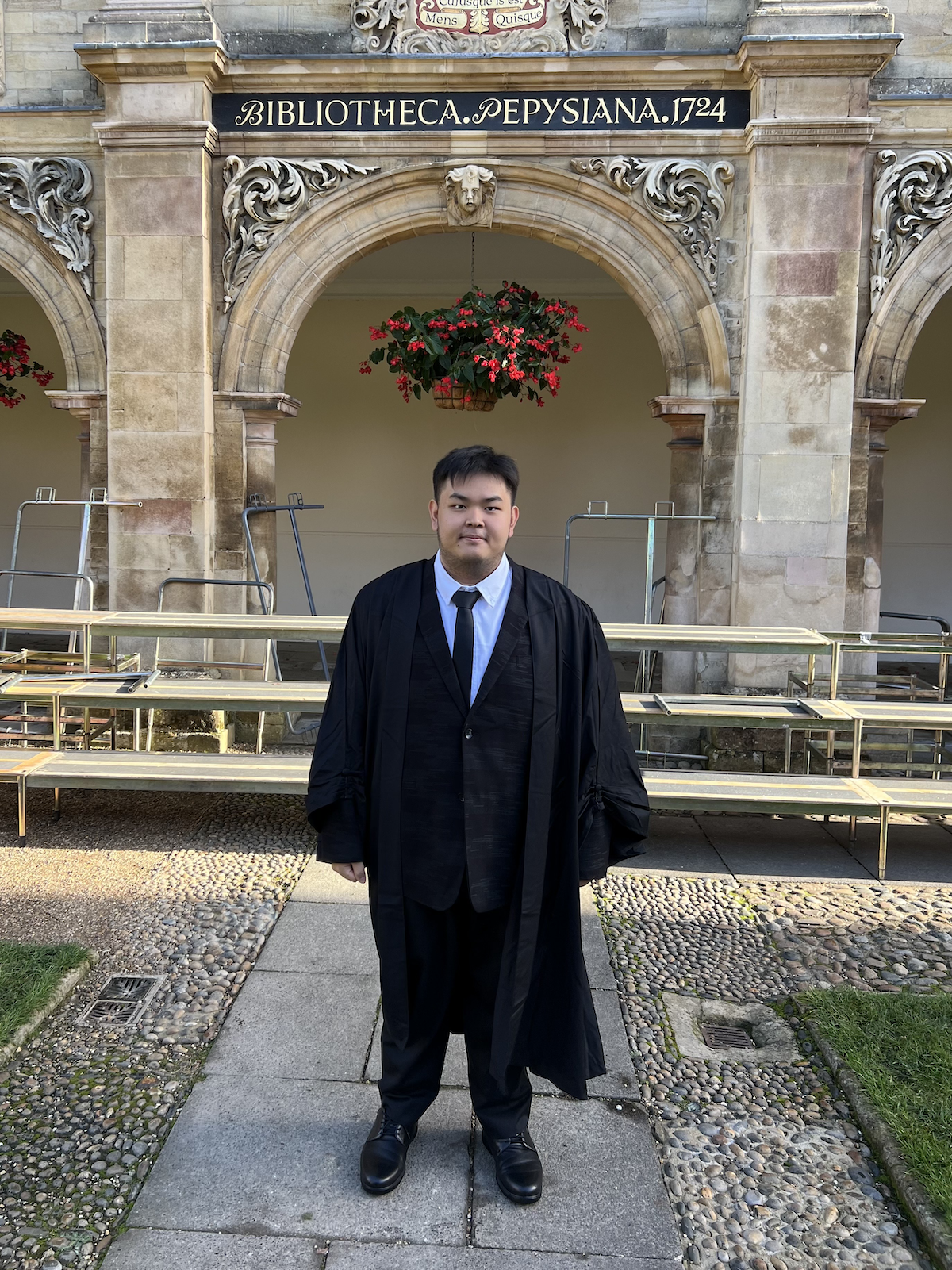
Photo courtesy of Zander Ong
What were your first impressions of Magdalene College and Cambridge University?
My first impression of Magdalene was its intimacy as a small college, which gives it a welcoming and close-knit atmosphere.
Cambridge, on the other hand, struck me with its tranquillity. The combination of historic architecture, scenic riverside views, and the rhythm of student life makes the city both peaceful and inspiring, a perfect environment to focus on learning and personal growth.
How would you describe the atmosphere and vibe at Magdalene? Do you enjoy it? Why or why not?
As the President of Magdalene College once shared with me during matriculation dinner, Magdalene has a wonderfully balanced and moderate atmosphere, with nothing extreme. The college has a vibrant mix of international and local students from diverse cultures and backgrounds, creating a rich and inclusive community. I’ve really enjoyed being part of this environment, as it has allowed me to broaden my perspectives by talking to people from different backgrounds, and still find my niche group where I feel a strong sense of belonging.
What has been the most fun and interesting new experience you’ve had in Cambridge?
Formals, punting, and visiting colleges are all new experiences that I’ve really enjoyed, but one that stands out to me the most is, surprisingly, the supervisions I’ve had in Cambridge. I’ve found most of my supervisions incredibly engaging due to the knowledgeable and supportive supervisors. These sessions have helped me clarify my thoughts, deepen my understanding, and gain new perspectives through thoughtful discussions. This experience has further strengthened my interest in the subject I’m studying, and I always look forward to my next supervision.
Was there a class or concept that significantly impacted the way you think?
Constitutional Law’s discussion on political constitutionalism, particularly the English constitution’s reliance on conventions, fundamentally reshaped my understanding of what constitutes law. I had previously viewed law as rigid, clear, and written, but this topic challenged that perspective. I came to appreciate the crucial role of conventions, which can, in some respects, be more enduring and influential than written laws that are subject to amendment. I found it particularly thought-provoking that ambiguity in conventions can potentially act as a restraint: when limits are undefined, actors may fear breaching unwritten norms and provoking serious consequences, which discourages them from testing boundaries. By contrast, clearly defined limits can unintentionally encourage actors to push right up to them. This insight extends beyond constitutional law: ambiguity often fosters caution and self-regulation in daily life, whereas overly precise rules may invite people to exploit loopholes or stretch boundaries. This concept gave me insights into how utilising ambiguity occasionally in real life might serve a greater purpose.
Has your time at Cambridge challenged or changed your perspectives?
I previously took for granted my ability to be optimistic, as I always hoped for the best outcome. At Cambridge, facing various failures in this competitive environment, I learnt that when things don’t go the way you think, sometimes the natural tendency to think positively is challenged, and you will have self-doubt. From this, I learnt that being optimistic requires conscious effort, such as building self-worth by finding your own unique strengths, being grateful for what you have, seeing that everyone’s starting point is different and hence comparison is pointless, and that good things take time.
What is the most interesting new insight you’ve gained?
Surprisingly, in an environment as academically intense as Cambridge, one of the most valuable insights I’ve gained is how to actively foster and strengthen friendships. Coming from high school where classmates naturally spent time together, I had never felt the need to intentionally maintain relationships. At Cambridge, where everyone’s schedules, classes, and societies differ, I learned that friendships require conscious effort: whether by organising or joining dinners, board games, or sports gatherings. I’ve come to appreciate that strong friendships are nurtured through intention and care, rather than being passively sustained.
How do you manage self-doubt or pressure in a competitive academic environment?
Firstly, I ground myself in gratitude, reminding myself of what I have already achieved and recognising how fortunate I am compared to many others.
Secondly, I build self-worth by setting self-comparison goals, which are targets I can fully control, such as the number of pages I aim to read from my reading list each day, rather than measuring myself against others through rankings. I’ve learned that you don’t need to be the best in the world to have self-worth. Everyone has different starting points, backgrounds, and strengths, which shape unique journeys.
Thirdly, I reframe setbacks as redirection rather than rejection. I believe everything happens for a reason, and every “no” offers lessons that guide me closer to the right opportunities. A concept I like to use is opportunity cost. Although it says that every choice made means an opportunity lost, it works the other way round as well: Every lost opportunity makes space for something else to be gained. This perspective allows me to see challenges and missed chances not as failures but as part of a bigger journey to a better future.
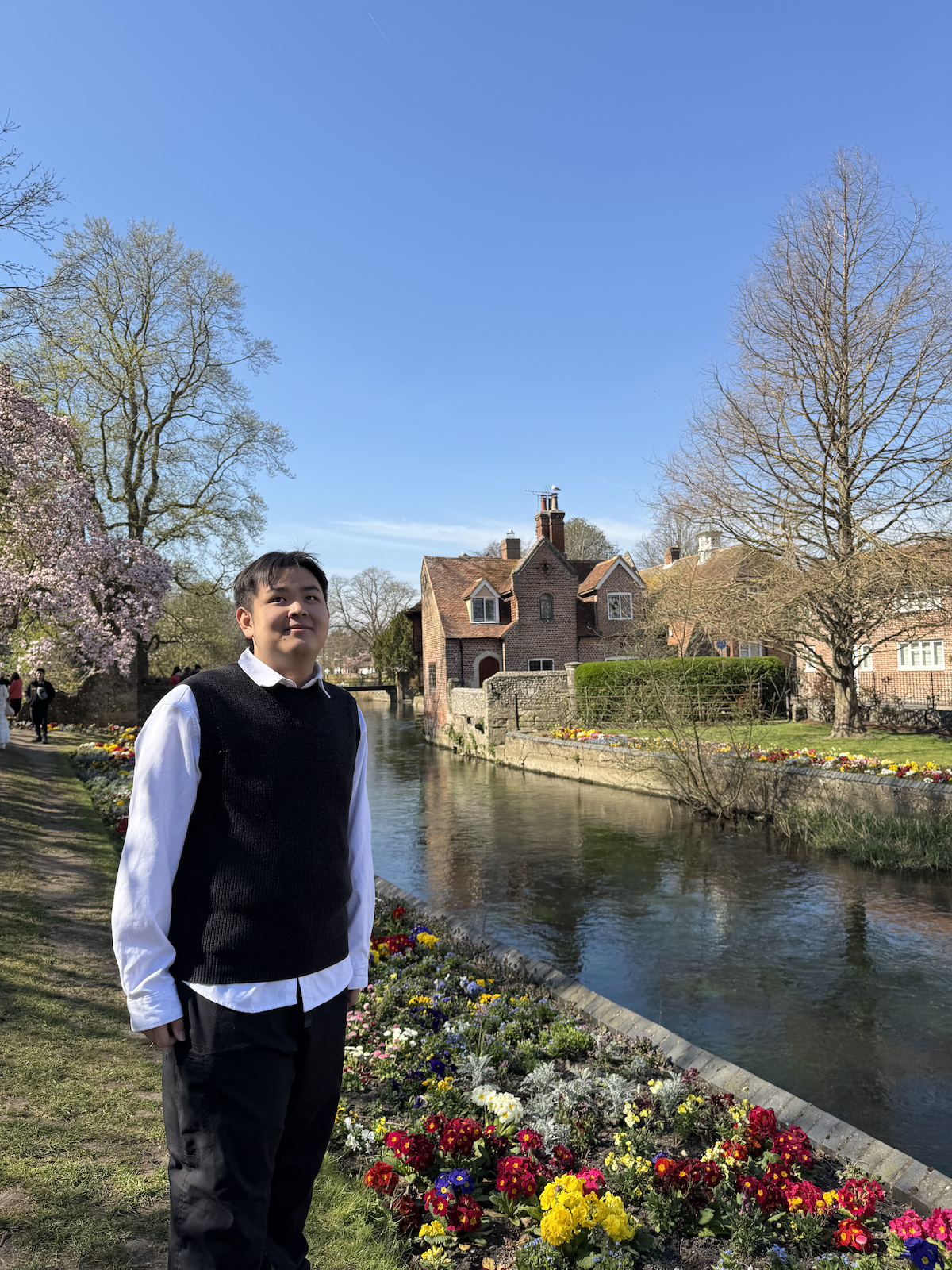
Photo courtesy of Zander Ong
What drives you when external motivation—like deadlines or grades—isn’t present?
What drives me when external motivation is absent is my passion and curiosity. When I’m genuinely interested in a subject, I feel naturally motivated to explore it in depth for its own sake, without any external reasons. For example, my interest in Constitutional Law often leads me to read proactively and engage with material well ahead of deadlines, simply because I genuinely want to know what the law is.
What advice would you give to a student currently considering applying for the YH2 Capital Scholarship?
My advice is to dream big. Never be your own rejector. Don’t let self-doubt or financial concerns stop you from applying to Cambridge or the YH2 Capital Scholarship, as you truly miss every opportunity you don’t take. Don’t assume it’s impossible before it’s done.
Secondly, be authentic and be yourself in your application. Take time to reflect on who you are, what you hope to gain from university, and what are the goals you want to achieve in life. Honesty, self-awareness, and ambition will make your application stand out.